
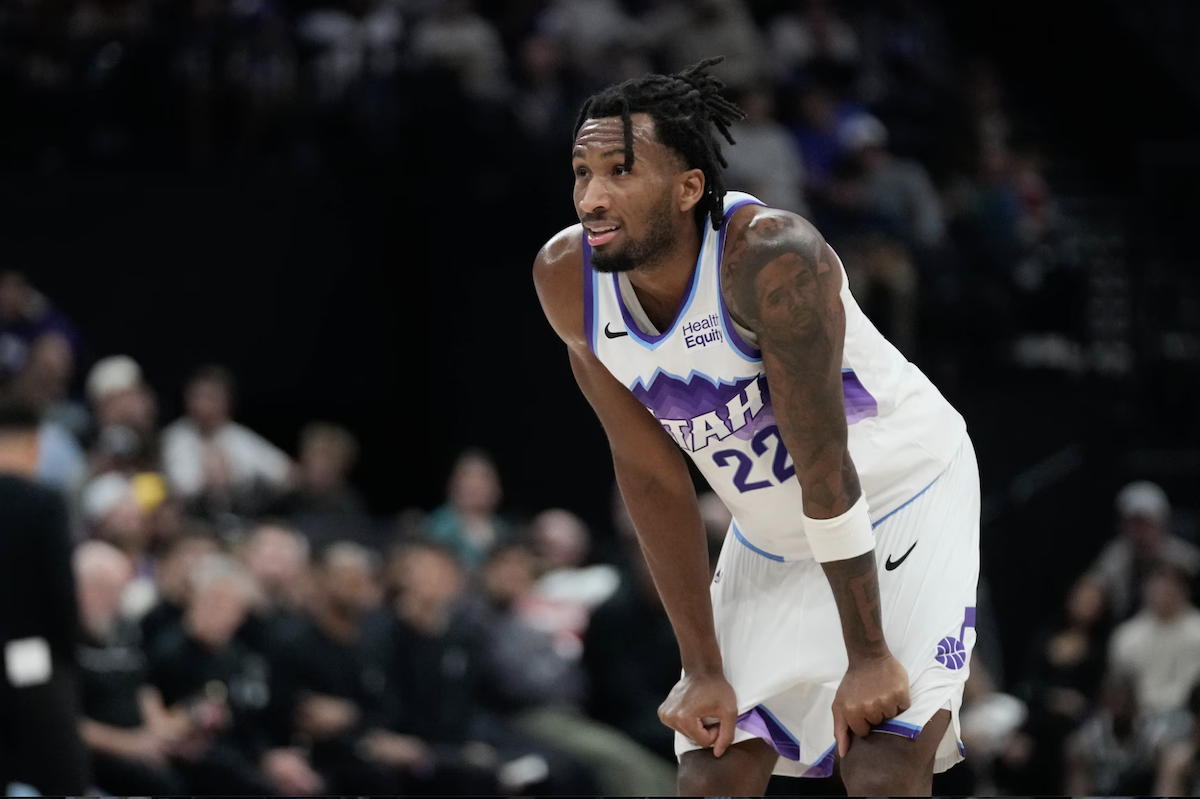

As overtime started for the Utah Jazz against the defending Western Conference champion San Antonio Spurs on Wednesday night, Darryn Peterson was on the bench. He also didn’t close the 4th quarter, and with Keyonte George temporarily unavailable in overtime, Isaiah Collier and Brice Sensabaugh started in Peterson’s place.
The offense immediately sputtered, and a promising upset turned into a 117-111 loss in Salt Lake City.
"We’ve got to clean up execution," Will Hardy stated postgame. "In those moments of the game, you have to be able to execute the game plan. I think Darryn is making a lot of strides, but in that moment, I felt it was better to go with Brice.”
The ensuing fan fury excoriated Will Hardy for not bringing Peterson back into the game to accelerate his development in crunch-time situations, or at least provide useful ballhandling and shooting skills to overtime lineups that could use them.
This will never be a space where I will advocate that Minutes = Development. That includes high-leverage, clutch situations, where I reject the common refrain that the only way to appreciate clutch time stress, and its requisite skills, is to actually be in the fray.
Getting crunch-time minutes does not magically grant skill points towards receiving a “Clutch Gene” badge in NBA 2K.
I don't think of it that way, coaches throughout the NBA certainly take a much more nuanced approach (considering way more factors than simply “Get The Rookie Some Experience”), and putting a player in a position to fail in those situations can very well make him worse if he's not actually prepared to meet the moment.
We all want to see Peterson exposed to these high-leverage situations as, ideally, the best player for the next Jazz championship contender. And certainly, a player who is relied upon for the right reasons in clutch situations could gain insights and strategies for the next go-around. But this is not guaranteed, nor is it all that likely if he has been struggling in a gameplay and execution element of that very game.
Reasonable minds can differ here. It’s okay.
As fans, it is fun[fn]Is it??[/fn] to wring hands over discrete rotation decisions, because it’s one of the very few coaching decisions we can (imperfectly) analyze without being able to attend practice or film sessions, or listen to in-game huddle adjustments.
But I also want to make sure we're clearly differentiating the two separate public criticisms of Hardy here, because I believe it is possible to hold two thoughts at the same time. We’re all smart, I promise we can do this.
1) We don’t like that Will Hardy didn’t play Darryn Peterson in overtime for development purposes.
Addressed mostly above, But I also want to take a brief moment to also address a post from Salt City Hoops Head Honcho Emeritus, Andy Larsen:
I feel like it should be well understood at this point that, especially for a team trying to bank wins as a primary motivator, a coach's decision about the rotation on a given night is about winning that night's contest. It is not about “preventing those mistakes in future games.” It’s about preventing those mistakes in THAT game! Peterson erred a number of times down the stretch (often with the same thing on the defensive end). NBA overtime is not the time for a coach to test whether his rookie will get it right the third, fourth, or fifth time down the floor, especially if he has other options.
Speaking of which, here is our other, simultaneous thought:
2) We don’t like that Will Hardy didn’t play Darryn Peterson in overtime, because the alternative lineup was ineffective.
Now, HERE, I think it is a little interesting!
George’s extra rest into overtime was to address a cramping issue, and Hardy had a very tough decision to make. Let’s start by assuming he had concerns about Peterson's execution errors in that moment[fn]Stay with me here, it's OK![/fn]. So he chose Isaiah Collier, who, as always, gives you a lot on the table and takes a lot off the table. And in this game, he had his crazy moments on his way to a +2. You never really know what you're getting with Collier on any given possession, but Hardy chose a player who was, to that point, executing specific gameplan elements more effectively. With the Spurs finally deciding to ramp up their ball pressure (they had been playing with their food all night), credible ballhandling was useful.
But the overall lineup wasn't set up to make use of what narrow situations Zay is highly effective. For better or worse, if Collier is on the floor, you usually need to run what I call ‘the Zay Offense.’ Hardy (and the players) were making chicken salad all night with lineups that frequently featured two, and even three, non-shooters on the floor. Jaxson Hayes was a must given his relative success against Victor Wembanyama and burgeoning chemistry with Collier. But then Hardy also felt that Josh Green needed to be out there for defense purposes, so you end up with:
- Isaiah Collier
- Brice Sensabaugh
- Josh Green
- Ace Bailey
- Jaxson Hayes
This offense is probably gonna have a bad time! And they did! Collier struggled with his patented paint-penetration skills with the swarm of Spurs defenders crashing into the paint off of the non-shooters to block his drives. He had to defer to Sensabaugh isolations when it failed. Note that this defense-first(ish) lineup prevented the Spurs from getting a basket until 2+ minutes passed in OT. I don’t completely hate trying to put a lid on BOTH rims while you wait for Keyonte to come back.
(Query whether Collier needed to be out there at all! Brice Sensabaugh’s isolation offense with fresh legs was a factor (as stated by Hardy post-game), so just set some top screens for Brice[fn]Or, dare I say, Ace Bailey, who also has natural midrange/pull-up skills worth exploring in a higher-pressure environment. You want to talk about development in crunch time? Let’s talk about THIS dude instead.[/fn] and let him try to jump shoot the team out of Keyonte’s extended rest. Add Josh Okogie for Collier and dare Wembanyama to keep shooting threes. This is, admittedly, a wilder idea that you can probably get away with more in January when your dudes have more familiarity with each other).
Which brings me all the way back to Peterson. With all of the limitations and hamstringing that I've just mentioned, would it not be useful, when Keyonte was temporarily hurt, to throw the “teaching moment” out the window? Would Peterson not actually be the best man for the job to win the game in front of you? Especially with the things he can put on the table, versus take off the table, as is the negotiation we have every time Collier steps on the floor?
This, and only this, is, I think, a reasonable tack to consider. It is also reasonable that, after Peterson has received the message that his crunch time contributions are now done for the night, suddenly giving him a pass when OT starts feels a little like telling your grounded teenager that they're actually off the hook when homecoming night comes around.
We unfairly consider these decisions as binary, 100% correct v. 0% correct, moments. After everything I've laid out above, with the errors that Peterson had made, especially defensively (which are MUCH more exploitable by a championship-caliber offense in overtime), tou can't tell me that the decision was undeniably, irredeemably foolish.
George himself has repeatedly lauded Hardy's approach to development and accountability. We are also seeing it with Bailey's improvement in year two. One game is not going to affect who Peterson will become, and these harder moments are not impeding anything.
But was Peterson, the player, the right man for the job, strategically? Let's hope he gets another chance, very soon, to show us why he was.


